

Hydraulic Hoses & Fittings In Nottingham Stapleford Hydraulic Co Ltd
Stapleford Hydraulic Co Ltd is a Nottinghamshire-based specialist in the supply, repair and manufacture of hydraulic hoses, rams, power units and ancillary equipment.
With a wealth of over 60 year’s industry experience, we supply a comprehensive range of hydraulic equipment and components to industrial and commercial customers throughout Nottingham, the surrounding areas and the rest of the United Kingdom.
Stapleford Hydraulic Co Ltd has a commitment to supplying high quality hydraulic products and the provision of excellent customer service in response to the needs of our customers. We stock a wide range of components from many suppliers and manufacturers, offering hydraulic hosing from 3/16” to 2” bore with the capability to 10,000 psi.
Hydraulic Fittings Repaired Whilst You Wait
Bring your hydraulic hose / fitting to our premises and we will repair or replace it whilst you wait. We stock a huge range of replacement parts and hydraulic components on site, with everything needed to repair or replace your fitting within a short turn around. More information about hydraulic hose repairs.
Can't Come To Us? No Problem.
We will collect the damaged part from your premises and return quickly with a new or replacement fitting.
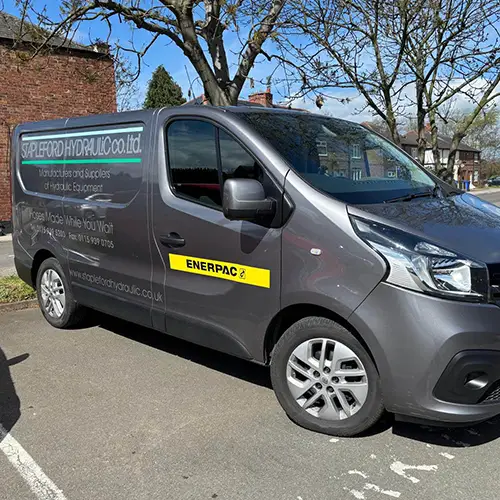
Enerpac Dealer
We also specialise in the supply and servicing of Enerpac hydraulic equipment and are an Enerpac dealer.
- Hydraulic Pumps
- Hydraulic Hoses
- Hydraulic Valves
- Hydraulic Clamps
- Hydraulic Cylinders
- Hydraulic Couplings & Fittings
- Hydraulic Rams
- Test Equipment
Industries We Serve
Hydraulic hoses and components are essential across a wide range of industries, and at Stapleford Hydraulic Co Ltd we have the experience and stock to support them all. We regularly supply and repair hydraulic components for customers working in:
- Agriculture & Farming
- Construction & Plant Hire
- Manufacturing & Engineering
- Haulage & Commercial Vehicles
- Waste Management & Recycling
- Forestry & Grounds Care
- Mining & Quarrying
- Civil Engineering
Whatever your industry, our team is on hand to provide fast, reliable hydraulic solutions tailored to your needs.
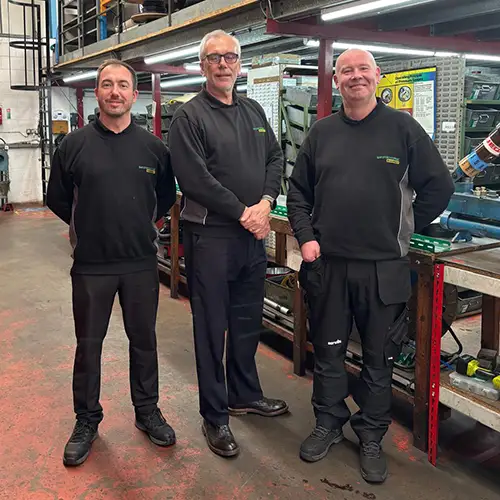
Why Stapleford Hydraulic Co Ltd?
With over 60 years of experience in the hydraulic industry, Stapleford Hydraulic Co Ltd is one of the East Midlands' most trusted suppliers of hydraulic hoses and fittings. Here's why customers keep coming back:
- Same Day Repairs: Most hoses repaired or replaced in 10–15 minutes.
- Huge Range In Stock: Hoses from 3/16" to 2" bore, rated up to 10,000 psi.
- Collection & Delivery: Available within a 20 mile radius for your convenience.
- Family Run Business: Personal, knowledgeable service every time.
- 3 Month Warranty: On all service repairs for complete peace of mind.
- Trade Accounts Welcome: Flexible payment options including credit cards and cash.
Frequently Asked Questions
-
What is the difference between working pressure and burst pressure on a hydraulic hose?
Working pressure is the maximum pressure a hose is rated to handle safely during continuous operation. Burst pressure is the point at which the hose will catastrophically fail under test conditions.
Industry standard hydraulic hoses are built to a 4:1 safety factor, meaning a hose rated at 5,000 psi working pressure will have a burst pressure of 20,000 psi. Burst pressure figures are for manufacturing test purposes only and should never be used as an operational target. -
How do I know if my hydraulic hose is the correct pressure rating for my system?
The hose must be rated to handle the maximum system pressure including any pressure spikes. Critically, the overall assembly pressure rating is determined by its weakest component. If a 4,000 psi hose is fitted with 3,500 psi fittings, the assembly is only rated to 3,500 psi. Always check the rating of every component, not just the hose itself.
-
What is the difference between braided and spiral hydraulic hose, and when should each be used?
Braided hose is the most common type, suited to medium and high pressure applications such as farm equipment, dump trucks and log splitters.
Spiral hose is heavier duty, designed for high-pressure and high-impulse applications such as mining equipment, earthmovers and cranes, where severe vibrations could cause braided reinforcement to stretch and separate over time. -
What does the minimum bend radius mean, and why does it matter?
The minimum bend radius is the tightest curve a hose can safely handle without sustaining internal damage. Exceeding it causes the reinforcement layers to break down, leading to early fatigue, leaks, and potential burst failure even under normal operating pressure.
If a hose is also subject to flexing during operation, the minimum bend radius must be increased further, typically by a factor of 1.1 to 1.5 depending on the degree of movement involved. -
What are the most common types of hydraulic hose fittings and how do I identify which one I have?
The most common hydraulic hose fitting types include JIC, NPT/NPTF, BSP, ORFS, Metric and SAE. Each uses a different sealing method.
JIC uses a 37° metal-to-metal flare, BSP uses threaded pipe connections, and ORFS (O-Ring Face Seal) uses a flat face with an O-ring for a leak-proof seal. If you are unsure, bring your fitting to us and our engineers can identify it immediately. -
What is the difference between BSP and JIC fittings?
BSP (British Standard Pipe) threads are the standard used across the UK and internationally, while JIC (Joint Industry Council) fittings use a 37° flare seating surface and are the most common American fitting type found in European applications. The two are not interchangeable, and using the wrong fitting type is a common cause of leaks and system failures.
-
What do SAE and ISO standards mean on a hydraulic hose?
SAE J517 standards define hose construction, design and minimum pressure ratings across the 100R series, such as 100R1 single-wire braid and 100R2 double-wire braid.
ISO 18752 is an internationally recognised standard that classifies hoses by pressure class and impulse resistance grade (A through D), making it easier to select the correct hose for high-cycle or severe-duty applications. -
How does fluid type affect which hydraulic hose I should use?
The hose must be fully compatible with the fluid being conveyed - this includes not just the inner tube, but also the outer cover, fittings and O-rings.
Different hydraulic fluids, including mineral oils, water-glycol solutions and synthetic fluids, can degrade incompatible hose materials over time, leading to contamination and premature failure. Always specify your fluid type when ordering a replacement hose. -
What causes hydraulic hoses to fail prematurely?
The most common causes of early hose failure include installation over the minimum bend radius, hose routing that causes twisting, pressure spikes beyond the rated working pressure, abrasion from contact with machinery, and fluid incompatibility.
Two of the most significant factors are installing a hose twisted or over-bent, both of which dramatically shorten service life and can cause the hose to burst at the fitting end. -
How often should hydraulic hoses be inspected or replaced?
Regular inspection is essential. Hoses should be checked periodically for signs of wear, abrasion, kinking, cracking and leaks.
As a general guideline, hydraulic hoses in high-cycle or high-pressure environments should be inspected at least every 12 months, though hoses on critical machinery may require more frequent checks. Age, operating conditions and visible deterioration should all be taken into account when deciding whether to replace. -
What is impulse pressure and why is it important when selecting a hose?
Impulse pressure refers to the cyclic pressure fluctuations a hose experiences during operation. It is critical for hoses in dynamic applications where pressure surges repeatedly, such as with directional valve shifts, cylinder movements or rapid load changes.
Repeated impulse loading causes cumulative fatigue in the hose structure over time. Hoses should be selected with an impulse rating appropriate for the severity of the application. -
Can the same hose be used for suction and pressure applications?
Not always. Suction hoses need to be specifically constructed to resist collapse under negative pressure (vacuum), whereas standard pressure hoses are designed to resist internal pressure only.
Using a standard hydraulic pressure hose in a suction application can cause the inner tube to collapse, restricting flow and potentially damaging the pump. Always specify whether the hose is required for pressure, suction or return line use when requesting a replacement.